
You start losing about one percent of your collagen every year after age 30, which is why your skin begins to sag and feel less firm over time. If you’ve noticed loose skin on your face, neck, or jawline, you’re not alone in feeling frustrated by the changes. The good news is that safe, effective skin tightening treatments exist that can restore firmness without surgery or long recovery times.
Table of Contents
- What Causes Skin to Lose Its Tightness
- Laser Treatments That Boost Collagen Production
- Microneedling and RF Treatments for Firmer Skin
- Injectable Biostimulators for Natural Tightening
- Choosing the Right Treatment for Your Skin Goals
- Your Path to Firmer, More Youthful Skin
- Common Questions About Skin Tightening
What Causes Skin to Lose Its Tightness
Your skin is basically held up by two proteins called collagen and elastin, which work like tiny springs and scaffolding under the surface. When you’re young, your body makes plenty of these proteins, keeping everything firm and bouncy. But starting around age 25, your body slows down production by about 1% each year, and the proteins you already have start breaking down faster than they’re replaced. Think of it like a mattress that loses its support over time—the structure is still there, but it just doesn’t hold up the same way anymore.
The Main Culprits Behind Loose Skin
Several factors team up to make your skin lose its grip. Some you can control, and others are just part of being human.
- Natural aging slows down collagen production and makes existing fibers weaker and more brittle
- Sun damage breaks down collagen through UV rays, which is why sun-exposed areas age faster
- Significant weight loss leaves behind stretched skin that can’t snap back without the fat underneath
- Genetics determine how quickly your skin ages and how much collagen you naturally produce
- Smoking and pollution create free radicals that attack and damage skin proteins
How Skin Structure Changes Over Time
The changes happen in layers you can’t see. Your dermis—the thick middle layer of skin—gets thinner and loses fat cells that once gave your face its plump, youthful shape. The collagen fibers that used to be organized and tight become loose and tangled, like a sweater that’s been washed too many times.
| Age Range | What’s Happening | Visible Signs |
|---|---|---|
| 20s-30s | Collagen production starts slowing down | Fine lines around eyes, subtle changes |
| 40s-50s | Elastin breaks down faster, fat pads shrink | Deeper wrinkles, mild sagging, volume loss |
| 60s+ | Significant protein loss, thinner skin layers | Pronounced sagging, jowls, loose neck skin |
Why Certain Areas Sag First
Not all skin ages at the same speed. Some spots on your face and neck are basically set up to lose firmness faster than others.
- The neck has thinner skin with less oil glands, making it more vulnerable to sagging and wrinkles
- Under-eye skin is the thinnest on your body and shows volume loss quickly
- Jowls form where facial fat pads slide down and skin can’t hold them in place anymore
- Areas with repeated movement (like around the mouth) break down collagen faster from constant folding
The good news is that modern skin tightening treatments can help rebuild what time takes away. At Beauty & Fly, treatments like Microneedling with PRP and the NOUVAderm laser work by triggering your body to make fresh collagen, essentially giving your skin’s support system a boost from the inside out.
Laser Treatments That Boost Collagen Production
Your skin loses about 1% of its collagen every year after age 20, which is why things start to sag and wrinkle over time. Laser treatments work by heating the deeper layers of your skin without damaging the surface, which tricks your body into thinking it needs to heal itself. This healing response kicks collagen production into high gear, and that’s what actually tightens your skin from the inside out. The best part is that this happens gradually, so you don’t end up with that overdone look that screams “I had work done.”

Laser Treatments That Boost Collagen Production
The NOUVAderm laser is designed specifically for this type of collagen stimulation while keeping downtime to a minimum. It targets multiple skin concerns at once, including loose skin, uneven texture, enlarged pores, and pigmentation issues.
- Improves skin tone and texture naturally
- Tightens pores for smoother appearance
- Reduces pigmentation and sun damage
- Minimal recovery time compared to older laser technology
During a treatment session, you’ll feel warmth on your skin as the laser energy penetrates the deeper layers. Most people describe it as tolerable, and the whole process usually takes 30 to 45 minutes depending on the treatment area. Your skin might look a bit pink afterward, similar to a mild sunburn, but this typically fades within a day or two.
Results don’t appear overnight because your body needs time to build new collagen. Most people start noticing tighter, smoother skin around the 4 to 6 week mark, with continued improvement over the next few months. The typical recommendation is a series of 3 to 4 treatments spaced about a month apart for optimal skin tightening results.
Microneedling and RF Treatments for Firmer Skin
Microneedling creates thousands of tiny channels in your skin using ultra-fine needles, which sounds intense but actually triggers one of the most powerful healing responses your body has. When your skin detects these micro-injuries, it rushes to repair them by producing fresh collagen and elastin. This natural repair process is what leads to firmer, tighter skin over the following weeks and months. The channels also allow beneficial ingredients to penetrate much deeper than they could otherwise.

Microneedling and RF Treatments for Firmer Skin
Adding PRP (platelet-rich plasma) to microneedling takes the results even further. Your own blood is drawn and processed to concentrate the platelets, which are packed with growth factors that accelerate healing and collagen production.
| Treatment Type | How It Works | Best For |
|---|---|---|
| Microneedling with PRP | Tiny needles create channels, PRP enhances healing | Fine lines, texture, mild laxity |
| Vivace Fractional RF | Combines microneedling with radiofrequency heat | Moderate laxity, deeper wrinkles, contouring |
The Vivace Fractional treatment combines microneedling with radiofrequency energy, which means you’re getting both the mechanical stimulation from the needles and the heat-based collagen production from the RF. This dual approach makes it particularly effective for skin tightening around the jawline, neck, and cheeks where sagging tends to be most noticeable.
At Beauty & Fly, these treatments are customized based on your specific skin concerns and goals. Catherine evaluates your skin and determines the optimal needle depth and treatment intensity for your needs.
You can expect some redness and slight swelling for about 24 to 48 hours after treatment. Most people return to normal activities the next day, though your skin might feel a bit sensitive. Visible improvements typically start around 3 to 4 weeks as new collagen forms, with continued enhancement over the next several months.
Injectable Biostimulators for Natural Tightening
Biostimulators are a completely different category from traditional dermal fillers, even though they’re both injected into the skin. While fillers add immediate volume by filling space under your skin, biostimulators work by stimulating your own body to produce more collagen over time. Think of fillers as adding stuffing to a pillow, while biostimulators are more like strengthening the fabric itself. This makes them ideal for addressing overall skin laxity rather than just filling specific lines or hollows.

Injectable Biostimulators for Natural Tightening
The way biostimulators work is pretty straightforward. Once injected into targeted areas, they trigger a controlled inflammatory response that signals your body to start building new collagen in that location.
- Cheeks and mid-face for lifted contours
- Jawline to improve definition and reduce jowling
- Neck area to address crepey skin and sagging
- Temples to restore lost volume
The results develop gradually over several weeks to months, which is actually a benefit because the changes look completely natural. Nobody will be able to pinpoint when you “had something done” because your face just looks progressively better and more refreshed.
Catherine’s injection technique focuses on strategic placement to achieve natural-looking skin tightening without creating an artificial appearance. With over 18 years of experience in aesthetic medicine, she understands facial anatomy and how to work with your natural structure rather than against it.
Most people need a series of 2 to 3 treatment sessions spaced about a month apart. The results can last up to two years or more because you’ve actually built new collagen, not just temporarily filled an area. Ideal candidates are those noticing early to moderate skin laxity who want gradual improvement without the commitment or downtime of surgery.
Choosing the Right Treatment for Your Skin Goals
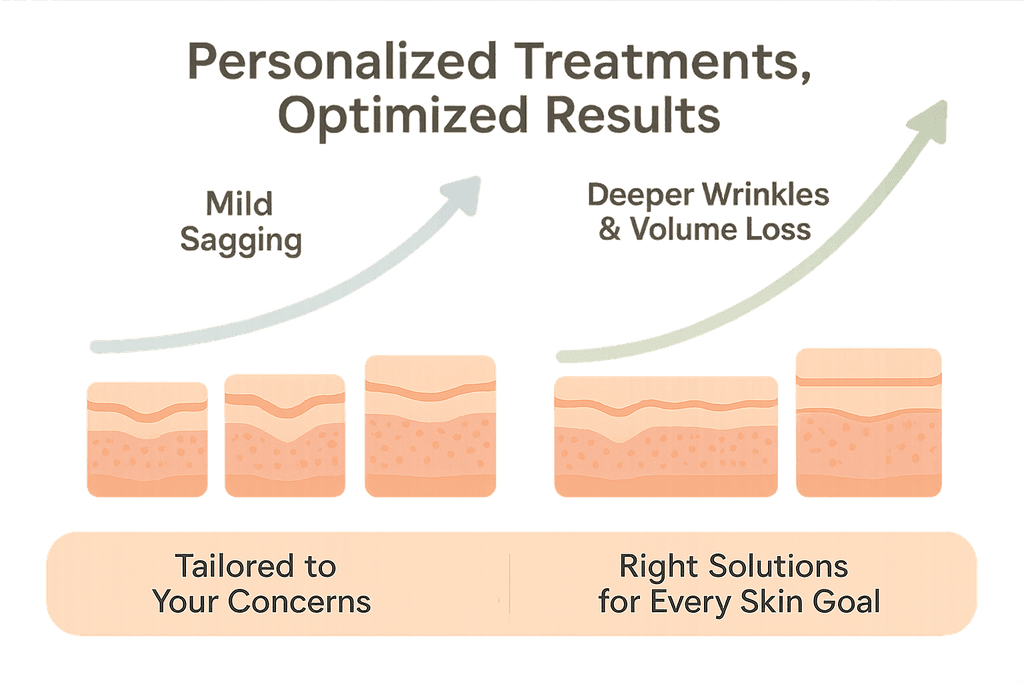
Not every skin tightening treatment works the same for everyone, and that’s actually a good thing. Your skin type, age, lifestyle, and what bothers you most about your appearance all play a role in which method will give you the best results. Someone with mild sagging around the jawline needs a different approach than someone dealing with deeper wrinkles and significant volume loss. The key is matching the treatment intensity to your actual concerns, not just picking whatever sounds most impressive.
The severity of your skin laxity determines your starting point. Early signs like fine lines and slight texture changes respond well to gentler options like microneedling or chemical peels. More advanced concerns might need stronger solutions like laser treatments or biostimulators that work deeper in the skin layers.
Factors That Shape Your Treatment Choice
- How much downtime you can realistically handle in your schedule
- Your budget and whether you prefer one bigger investment or smaller regular treatments
- Pain tolerance and comfort level with different procedures
- Whether you want gradual improvements or faster visible changes
- Your skin’s natural healing ability and any underlying conditions
Here’s something most people don’t realize until they start researching skin tightening options. Combining treatments often delivers better results than relying on just one method. At Beauty & Fly, Catherine Curtin frequently creates custom plans that layer different approaches, like pairing microneedling with PRP therapy or following laser treatments with biostimulators.
Questions to Ask Yourself When Considering Skin Tightening Treatments
- What specific areas of my face or body bother me most?
- Am I looking for prevention or correction of existing concerns?
- How soon do I need to see results?
- Can I commit to multiple sessions if needed?
- What’s my realistic budget for ongoing maintenance?
The truth is, no provider can tell you the right answer without actually seeing your skin and hearing your goals. That’s why personalized consultation matters so much in aesthetic medicine. Catherine’s approach involves really listening to what you want and then explaining which treatments will actually get you there, not just selling you the most expensive option.
Setting realistic expectations from the start saves disappointment later. Non-surgical skin tightening works, but it won’t give you surgical facelift results. What it does offer is natural improvement without the risks, cost, and recovery time of going under the knife.
Your Path to Firmer, More Youthful Skin
The good news is that you don’t need surgery to see real improvements in skin tightening. Modern treatments like microneedling with PRP, NOUVAderm laser, and Vivace Fractional work by triggering your body’s natural collagen production, which means the results look natural and develop over time. These methods have been tested and refined over years, so when done correctly, they’re both safe and effective. The key word there is “correctly,” because not all providers have the same level of training or experience.
Working with someone who really knows what they’re doing makes all the difference. At Beauty & Fly, Catherine Curtin brings over 18 years of aesthetic medicine experience to every treatment, and she’s the only provider you’ll see, which means your care stays consistent from start to finish. She actually teaches other practitioners these techniques, so you’re getting expertise that goes beyond just performing procedures.
The best approach to skin tightening isn’t one-size-fits-all. Your skin’s needs are different from everyone else’s, which is why a personalized consultation matters so much. During that conversation, you can talk about what’s bothering you most, what results you’re hoping for, and which treatments might work best together.
If you’re in the Bronxville or Bridgehampton area and you’ve been thinking about firmer skin, it might be time to have that conversation. Sometimes the hardest part is just taking the first step.
Common Questions About Skin Tightening
If you’re thinking about skin tightening treatments, you probably have some questions about how they work and what to expect. Most people wonder about the same things before their first appointment. Here are the answers to the questions we hear most often at Beauty & Fly, so you can feel confident about your decision.
How long do skin tightening results last?
Results vary depending on which treatment you choose and how your body responds. Most people see results that last anywhere from six months to two years. Treatments like NOUVAderm laser and Microneedling with PRP work by stimulating your body’s natural collagen production, which means results develop gradually and can last longer than you might expect. Your lifestyle, age, and skin condition all play a role in how long you’ll enjoy your results.
Is skin tightening painful?
Most skin tightening treatments cause minimal discomfort, not actual pain. You might feel warmth, tingling, or a slight prickling sensation during the procedure. Many treatments include numbing cream or cooling technology to keep you comfortable. The Vivace Fractional treatment at Beauty & Fly, for example, uses microneedling with radiofrequency but includes measures to minimize any discomfort during the session.
How many treatments will I need?
This depends on your starting point and your goals. Most people need between three to six sessions spaced a few weeks apart to see their best results. Some treatments show improvement after just one session, while others build results over time. Catherine Curtin creates a personalized treatment plan during your consultation based on what your skin needs and what you want to achieve.
Can I combine different skin tightening methods?
Yes, and combining treatments often gives better results than using just one method. You might pair laser treatments with PRP therapy, or add biostimulators to your microneedling sessions. The key is working with someone experienced who understands how different treatments work together safely and effectively.
What’s the difference between skin tightening and fillers?
Skin tightening treatments work by stimulating your own collagen production to firm and lift your skin from within. Fillers add volume to specific areas by injecting gel-like substances under the skin. Think of skin tightening as improving the quality and firmness of your skin, while fillers restore lost volume in targeted spots like cheeks or lips.
Am I too young or too old for skin tightening treatments?
There’s no perfect age for skin tightening. People in their late twenties sometimes start preventive treatments, while others wait until their fifties or beyond. What matters most is your skin’s condition and your personal goals. If you’re noticing sagging, loss of firmness, or texture changes that bother you, you’re probably a good candidate regardless of your age.