
You’ve probably seen someone with that stiff, frozen look after BOTOX and thought, “I never want that to happen to me.” The truth is, that unnatural appearance doesn’t come from BOTOX itself—it comes from poor technique, wrong dosing, or treating the wrong muscles. At Beauty & Fly, Catherine Curtin uses precise placement and careful dosing to smooth lines while keeping your face naturally expressive, so you look refreshed instead of frozen.
Table of Contents
- What BOTOX Actually Does to Your Muscles
- Why Dosing and Placement Make All the Difference
- The Muscles You Want to Relax vs. Preserve
- How Your Provider’s Experience Shapes Your Results
- Why Natural Results Take Patience and Partnership
- Your Face, Just Refreshed
- Common Questions About Natural BOTOX Results
What BOTOX Actually Does to Your Muscles
Your face has over 40 different muscles working together every time you smile, frown, or raise your eyebrows. When you make the same expression thousands of times over the years, those muscles create creases in your skin. BOTOX works by temporarily relaxing specific muscles that cause these lines, giving your skin a chance to smooth out. The treatment doesn’t freeze your entire face—it just calms down the muscles that are working too hard and creating unwanted wrinkles.
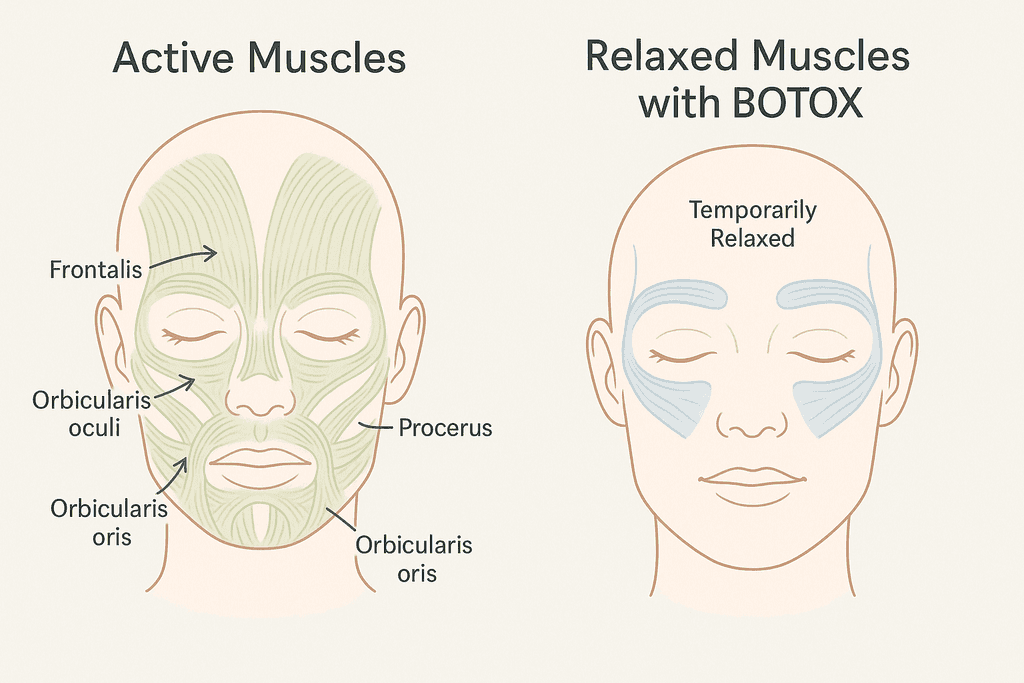
How Muscle Relaxation Creates Smoother Skin
When BOTOX is injected into a muscle, it blocks the signal between your nerves and that muscle. Think of it like turning down the volume on a radio instead of shutting it off completely. The muscle can still move, but it moves less intensely. This gives the skin above it time to recover and smooth out.
At Beauty & Fly, Catherine Curtin uses her deep understanding of facial anatomy to target only the muscles causing your specific concerns. The goal is always to keep your natural expressions while reducing the lines that bother you. Research shows that BOTOX affects how facial muscles communicate with the brain, which is why precision matters so much.
Understanding Dynamic Versus Static Wrinkles
Not all wrinkles form the same way, and that changes how we treat them. Dynamic wrinkles appear when you move your face—like crow’s feet when you smile or forehead lines when you raise your eyebrows. Static wrinkles stay visible even when your face is relaxed. BOTOX works best on dynamic wrinkles because it addresses the muscle movement causing them.
| Wrinkle Type | When Visible | Best Treatment |
|---|---|---|
| Dynamic | During facial expressions | BOTOX neuromodulators |
| Static | At rest | Dermal fillers or lasers |
| Mixed | Both times | Combination approach |
Why Some Muscles Get Treated and Others Don’t
Your facial muscles work as a team. Some muscles pull your features up, while others pull them down. Treating the wrong muscles can create an unnatural look or affect expressions you want to keep. That’s why experience matters so much with BOTOX injections.
The muscles most commonly treated include:
- Frontalis muscle (forehead lines)
- Corrugator and procerus muscles (frown lines between eyebrows)
- Orbicularis oculi (crow’s feet around eyes)
- Masseter muscle (jaw tension and slimming)
Other muscles are left alone because they’re essential for natural-looking expressions. The key is knowing exactly how much to relax each muscle without affecting the ones around it. This precision is what creates natural-looking results instead of a frozen appearance.
Why Dosing and Placement Make All the Difference
The difference between looking refreshed and looking frozen often comes down to just a few units of BOTOX. Most people don’t realize that BOTOX is measured in tiny units, and the amount you need depends entirely on your unique facial structure, muscle strength, and aesthetic goals. A forehead that needs 20 units for one person might only need 12 for another. This is why the cookie-cutter approach you sometimes see at chain clinics can lead to disappointing results.

Why Dosing and Placement Make All the Difference
When providers use the same dosing protocol for everyone, they’re essentially ignoring what makes your face uniquely yours. Your muscles move differently than anyone else’s, and treating everyone the same creates that telltale frozen appearance nobody wants.
- Units are customized based on muscle strength and treatment area
- Conservative dosing allows natural movement while smoothing lines
- Strategic placement targets wrinkle-causing muscles without affecting expression
- Follow-up adjustments fine-tune results for your specific needs
An experienced provider like Catherine Curtin at Beauty & Fly spends time assessing how your facial muscles actually move before ever picking up a syringe. With 18 years of experience in aesthetic medicine, she understands that the goal isn’t to paralyze your face. It’s to relax the specific muscles that create unwanted lines while preserving the ones that give you character and expression.
The placement of each injection matters just as much as the dose. A millimeter in the wrong direction can mean the difference between a naturally lifted brow and a surprised look. This precision comes from understanding facial anatomy at a deep level and having the artistic eye to see how small adjustments create balanced, natural-looking results.
The Muscles You Want to Relax vs. Preserve
Your face has over 40 different muscles working together to create expressions, but only a handful of them are responsible for the lines that age you. The corrugator muscles between your eyebrows create those vertical “11” lines that make you look angry even when you’re not. The frontalis muscle across your forehead causes horizontal lines when you raise your eyebrows. And the orbicularis oculi around your eyes creates crow’s feet when you smile or squint.

The Muscles You Want to Relax vs. Preserve
These are the muscles that benefit from BOTOX treatment. But here’s what many people don’t understand: not every muscle should be treated.
| Muscles to Treat | Muscles to Preserve |
|---|---|
| Corrugators (frown lines) | Lower frontalis (natural brow movement) |
| Upper frontalis (forehead lines) | Zygomatic muscles (genuine smile) |
| Orbicularis oculi (crow’s feet) | Levator muscles (eye opening) |
The muscles that create your natural expressions need to keep working. When providers treat too aggressively or inject in the wrong spots, they can affect the muscles responsible for authentic smiles, natural eyebrow movement, and the subtle expressions that make you look like yourself. This is exactly how people end up with that frozen, mask-like appearance.
Strategic treatment means your eyebrows can still move when you’re surprised or skeptical. Your smile still reaches your eyes. You can still show concern or concentration without those deep furrows appearing. The art is in knowing exactly which muscles to relax and which ones to leave alone, creating a balance that looks completely natural.
How Your Provider’s Experience Shapes Your Results
Anyone can learn to inject BOTOX, but creating beautiful, natural results requires something beyond basic training. It’s both a science and an art form. The science part involves understanding facial anatomy, muscle function, and how neuromodulators work at a cellular level. The art part is harder to teach because it requires a trained eye for facial balance, symmetry, and the subtle nuances that separate good results from exceptional ones.
An experienced injector watches how your face moves before treatment begins. They notice which side of your forehead is stronger, whether one eyebrow sits higher than the other, and how your expressions change when you talk or smile. These observations inform every decision about where to inject and how much to use.
What to look for in a BOTOX provider:
- Board certification in a medical field
- Years of specific experience with cosmetic injections
- Ongoing training in advanced techniques
- A portfolio showing natural-looking results
- Time spent assessing your face before treatment
- Willingness to start conservatively
Catherine’s role in training other aesthetic professionals speaks to her level of expertise. When you’re teaching others how to achieve natural-looking BOTOX results, you’ve moved beyond basic competency into true mastery. This depth of knowledge means she can handle complex cases, make subtle adjustments, and create results that enhance rather than change your appearance.
Seeing the same provider consistently also matters more than most people realize. When Catherine treats you at Beauty & Fly, she remembers how your face responded to previous treatments. She knows your preferences, understands your goals, and can fine-tune your results over time in ways that aren’t possible when you see a different injector each visit. This continuity of care is one reason patients report such consistently natural outcomes.
Why Natural Results Take Patience and Partnership
Most people expect BOTOX to work like a light switch, but the reality is more like watching a photograph develop. The full effects don’t show up overnight, and that’s actually a good thing. When you understand the timeline and work with an experienced provider, you end up with results that look like you, just refreshed. At Beauty & Fly, Catherine Curtin takes a measured approach that prioritizes your comfort with the outcome over rushing to dramatic changes.
The Real Timeline for BOTOX Results
The science behind how BOTOX works explains why patience matters. The neurotoxin needs time to interrupt the signals between your nerves and muscles, and this doesn’t happen all at once.
- Initial effects start appearing around 3-5 days after injection
- Peak results typically show up at the two-week mark
- Full muscle relaxation continues developing through week three
- Individual metabolism affects how quickly you see changes
Starting Small Leads to Better Outcomes
There’s a reason experienced providers like Catherine start conservatively with first-time patients. You can always add more BOTOX at a follow-up appointment, but you can’t take it away once it’s working. Starting with fewer units lets you see how your face responds without overshooting into that frozen look nobody wants.
- Conservative dosing preserves natural facial movement
- First treatments establish your personal baseline response
- Gradual adjustments build trust between you and your provider
Why Follow-Up Appointments Matter
The two-week follow-up isn’t just a formality. This is when your provider can see exactly how your muscles responded and make any needed adjustments. Research shows that BOTOX affects facial expressions in nuanced ways, which is why checking in after full results develop helps fine-tune your treatment.
- Allows for touch-ups in areas that need more relaxation
- Helps identify your ideal dosing for future sessions
- Creates opportunity to discuss what you like or want adjusted
- Builds a treatment history that improves each visit
Results Improve with Consistency
Your second and third BOTOX sessions typically work better than your first. Regular treatments train your muscles to relax, and many people find they need less product over time. This is where the partnership with your provider really pays off, as they learn your face and you learn what to expect.
Your Face, Just Refreshed
The difference between looking frozen and looking refreshed comes down to one thing: the person holding the syringe. BOTOX works the same way in everyone’s face, but how it’s used makes all the difference. A provider who takes time to understand your facial movements, listens to what you actually want, and treats you as an individual rather than following a template will give you natural-looking results every single time.
Your expressions are what make you recognizable to the people who love you. The goal isn’t to erase them but to soften the lines that form around them. When done right, BOTOX should make people wonder why you look so well-rested, not whether you’ve had work done.
At Beauty & Fly, Catherine Curtin approaches every treatment with this exact philosophy. Her 18 years of experience means she knows exactly where to place injections to smooth lines while keeping your face mobile and expressive. The customized treatment plans she creates aren’t about following trends or using the same dose on everyone.
If you’ve been hesitant about trying BOTOX because you’ve seen results that look overdone, that concern is valid. But it’s also avoidable when you work with someone who prioritizes subtlety over dramatic change. The questions below cover some of the most common concerns people have before their first appointment.
Common Questions About Natural BOTOX Results
Getting BOTOX for the first time brings up a lot of questions, especially if you’ve seen those frozen faces that make people look like they can’t smile anymore. The good news is that when done right, BOTOX should never leave you looking stiff or expressionless. At Beauty & Fly, Catherine Curtin focuses on natural-looking results that let your personality shine through while smoothing away the lines that bother you most. Here are the answers to the questions we hear most often from patients who want to keep things real.
How long does BOTOX last with natural dosing?
Most people see their natural-looking results last between three to four months, though this can vary based on your metabolism and how expressive you naturally are. Some patients find their results last a bit longer with repeated treatments over time. The key is that natural dosing doesn’t mean shorter results, it just means you’ll still look like yourself while those lines soften.
Will I still be able to make facial expressions?
Absolutely. When BOTOX is applied with a light hand and proper technique, you’ll still be able to smile, laugh, frown, and show surprise. The goal is to relax the muscles that create deep lines, not to paralyze your entire face. You should never feel like you’re wearing a mask.
What happens if I don’t like my results?
The effects of BOTOX are temporary, so even if something feels off, it will gradually wear off over the next few months. That said, working with an experienced provider like Catherine makes this scenario unlikely since she takes time to understand exactly what you want before any injections happen. She’ll also see you for a follow-up to make sure you’re happy with how everything settled.
How do I avoid the frozen look?
The frozen look happens when too much product is used or when it’s placed in the wrong spots. Choosing a provider who values natural results over dramatic changes makes all the difference. Catherine’s approach at Beauty & Fly focuses on subtle improvements that enhance your features rather than erasing all movement from your face.
When will I see results from my treatment?
You’ll start noticing changes within three to five days, with full results appearing around two weeks after your appointment. This gradual onset actually helps create that natural look since the changes aren’t sudden or shocking.
Can BOTOX be reversed if needed?
While there’s no instant reversal for BOTOX like there is for some fillers, the effects do wear off naturally within a few months. In rare cases where adjustment is needed, your provider can work with you on the next treatment to fine-tune the results. The temporary nature of BOTOX is actually one of its benefits, giving you the chance to adjust your approach over time.