
Those dark spots and rough patches on your face aren’t just showing up randomly—they’re the result of years of sun exposure finally catching up with your skin. A chemical peel works by removing those damaged outer layers to reveal the healthier skin hiding underneath, something your drugstore creams simply can’t do. At Beauty & Fly, we use professional-grade peels like the VI Peel to target sun damage at the depth it actually lives, not just on the surface.
Table of Contents
- What Sun Damage Actually Does to Your Skin
- How Chemical Peels Reverse Sun Damage
- What to Expect During and After Treatment
- Professional Peels vs At-Home Options
- Why Chemical Peels Work Better Than Other Treatments
- Getting Started with Chemical Peels
- Common Questions About Chemical Peels for Sun Damage
What Sun Damage Actually Does to Your Skin
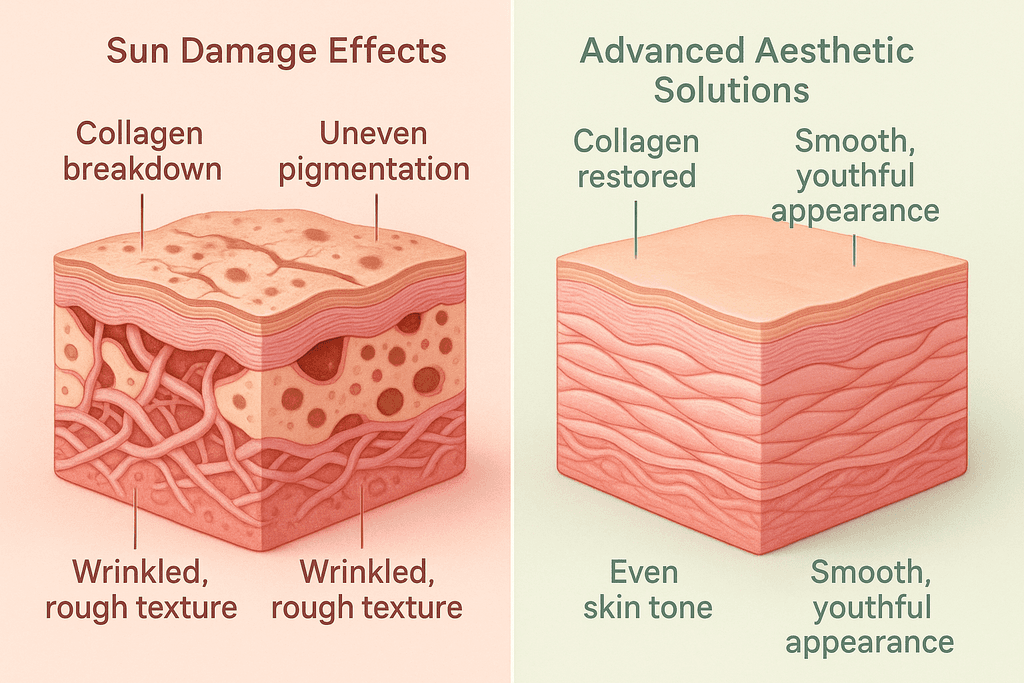
Your skin remembers every sunny day you spent outside, even the ones from decades ago. UV rays don’t just cause a temporary sunburn and disappear. They actually penetrate deep into your skin layers, causing damage that builds up over time. The sun’s radiation breaks down collagen fibers, damages DNA in skin cells, and triggers your body to produce extra melanin in uneven patches. This is why sun damage shows up as dark spots, rough texture, and wrinkles that seem to appear out of nowhere.
How UV Rays Attack Different Skin Layers
The sun hits your skin with two types of harmful rays, and each one causes its own kind of trouble. UVA rays go deep into the dermis where your collagen lives, while UVB rays damage the outer epidermis. Both types work together to age your skin faster than it should.
- UVA rays break down collagen and elastin, causing sagging and deep wrinkles
- UVB rays damage surface cells, leading to rough texture and precancerous changes
- Both types trigger melanocytes to overproduce pigment in scattered areas
- DNA damage accumulates in cells, making them less able to repair themselves
Visible Signs That Show Up on Your Face
Sun damage doesn’t look the same on everyone. Some people get dark spots while others notice their pores getting bigger or their skin feeling like sandpaper. The type of damage you see depends on how deep the UV rays went and how long your skin has been exposed.
| Type of Sun Damage | What It Looks Like | Which Skin Layer |
|---|---|---|
| Hyperpigmentation | Brown spots, freckles, uneven tone | Epidermis (surface) |
| Rough Texture | Bumpy, sandpaper-like feel | Epidermis |
| Enlarged Pores | Visible holes, especially on nose and cheeks | Epidermis to upper dermis |
| Fine Lines | Small wrinkles around eyes and mouth | Upper dermis |
| Deep Wrinkles | Creases that don’t smooth out | Deep dermis |
Why Your Skin Stops Fixing Itself
When you’re young, your skin can bounce back from sun exposure pretty well. But as you get older, your body’s natural repair system slows way down. Cell turnover drops from every 28 days to every 40 or 50 days. Your collagen production decreases by about 1% each year after age 20.
- Slower cell turnover means damaged cells stick around longer
- Less collagen production means skin can’t rebuild its structure
- Weakened repair enzymes struggle to fix DNA damage
This is where professional treatments like a chemical peel can help your skin by removing damaged layers and triggering fresh cell growth. At Beauty & Fly, our VI Peel treatments work at different depths to address whatever type of sun damage you’re dealing with, whether it’s surface spots or deeper texture issues.
How Chemical Peels Reverse Sun Damage
Sun damage doesn’t just sit on the surface of your skin. Those dark spots, rough patches, and fine lines actually live in different layers beneath what you can see. A chemical peel works by using controlled acids to remove these damaged layers, kind of like peeling away the damaged pages of a book to reveal fresh ones underneath. The process sounds intense, but it’s actually how your skin naturally wants to heal itself—we’re just giving it a strategic push in the right direction.

How Chemical Peels Reverse Sun Damage
The strength of the peel determines how deep it goes. Superficial peels handle surface-level issues like mild discoloration, while medium and deep peels reach further to address more stubborn sun damage that’s been building up for years.
- Superficial peels target the outermost layer for minor sun damage and texture issues
- Medium peels penetrate deeper to address moderate sun spots and wrinkles
- Deep peels reach the lower dermal layers for severe photodamage
- The VI Peel combines multiple acids to treat various types of sun damage simultaneously
What makes chemical peels effective isn’t just the removal of damaged skin. When you remove those damaged layers, your body kicks into healing mode and starts producing fresh collagen and new skin cells. This is where the real magic happens—your skin doesn’t just look better because the bad stuff is gone, but because new, healthier skin is actively being created.
The results don’t appear overnight. As the damaged skin gradually sheds over several days, the fresh skin underneath emerges with improved tone and texture. Research shows that chemical peels trigger significant cellular renewal, which is why they remain one of the most reliable treatments for reversing sun damage.
What to Expect During and After Treatment
The actual treatment is surprisingly quick and straightforward. Most chemical peel sessions take between 30 and 45 minutes from start to finish. You’ll feel some tingling or mild warmth as the solution is applied, but it’s not the burning sensation people often worry about. The discomfort is minimal and temporary, and most people find it completely manageable without any numbing agents.
Here’s what happens after you leave the treatment room. Your skin might look a bit red and feel tight, similar to a mild sunburn. This is completely normal and actually means the peel is doing its job.
The peeling process typically follows this pattern:
- Days 1-2: Skin feels tight and may appear slightly red
- Days 2-3: Peeling begins, usually starting around the mouth and nose
- Days 3-7: Active peeling continues as damaged skin sheds
- Days 7-14: New skin is fully revealed with improved texture and tone
Most people return to their normal activities right away. The key is protecting your skin from sun exposure during the healing process, since your new skin is more vulnerable to UV damage. Think of it like protecting a fresh tattoo—you wouldn’t expose it to harsh conditions while it’s healing.
The VI Peel that we use at Beauty & Fly is designed to minimize downtime while maximizing results. You can wear makeup after the first day if needed, though your skin will be going through its natural shedding process underneath. For severe sun damage, multiple treatments spaced several weeks apart often deliver the most dramatic improvement.
Professional Peels vs At-Home Options
Walk into any beauty store and you’ll find dozens of at-home chemical peel products promising similar results to professional treatments. The difference comes down to strength and customization. Professional-grade peels use acid concentrations that simply aren’t available in retail products—and for good reason. These stronger formulations require proper training to apply safely and effectively.

Professional Peels vs At-Home Options
At-home peels typically contain around 10-30% acid concentration. Professional peels can range from 30% to 70% or higher, depending on the specific treatment and your skin’s needs.
| At-Home Peels | Professional Peels | |
|---|---|---|
| Acid Strength | 10-30% | 30-70%+ |
| Penetration Depth | Surface only | Multiple skin layers |
| Customization | One-size-fits-all | Tailored to your skin |
| Results Timeline | Subtle, gradual | Visible within 1-2 weeks |
The real advantage of professional treatment goes beyond just strength. When you work with an experienced provider, they assess your specific type of sun damage, your skin type, and your goals before selecting the right peel formulation. The VI Peel combines multiple acids—including TCA, salicylic acid, retinoic acid, and vitamin C—to address different aspects of sun damage simultaneously. Medical-grade peels can target both surface discoloration and deeper structural damage that at-home products simply can’t reach.
Professional application also ensures even coverage and proper neutralization. Uneven application can lead to patchy results or irritation, and knowing exactly when to neutralize the peel prevents complications. This level of precision and safety is what separates a professional treatment from a DIY approach.
Why Chemical Peels Work Better Than Other Treatments
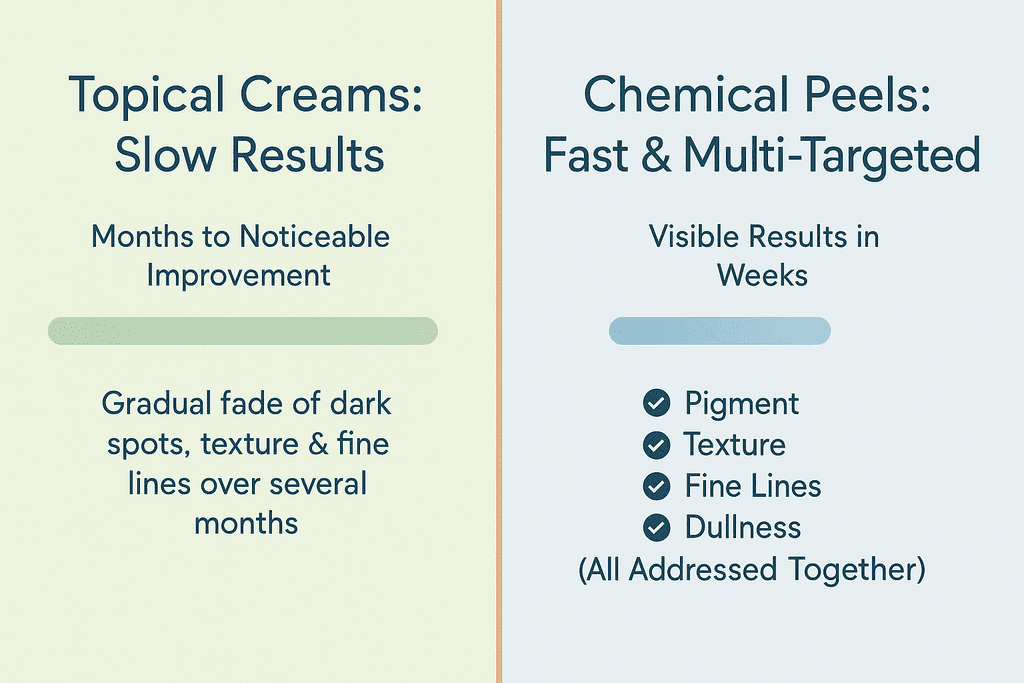
When you compare treatment options for sun damage, chemical peels stand out for a few practical reasons. They tackle multiple problems at once—pigmentation, texture, fine lines, and dullness—all in a single session. Most topical creams take months to show even minor improvements, while a chemical peel can deliver visible results in just a few weeks. That speed matters when you’re dealing with stubborn dark spots or rough patches that make you feel self-conscious.
The cost factor is worth considering too. Laser treatments can run thousands of dollars and often require multiple sessions to see results. Chemical peels offer a middle ground—more effective than drugstore products but less invasive and more budget-friendly than laser procedures. For many patients, this makes peels the sweet spot between affordability and actual results.
Key Advantages of Chemical Peels
- Address pigmentation, texture, and fine lines simultaneously instead of treating one issue at a time
- Show visible improvements within 1-2 weeks compared to months with topical products alone
- Work well for most skin types when customized properly by an experienced provider
- Require minimal downtime compared to more aggressive laser treatments
What really sets chemical peels apart is their flexibility. At Beauty & Fly, Catherine Curtin customizes each VI Peel based on your specific sun damage concerns and skin type. This personalized approach means you’re not getting a one-size-fits-all treatment that might work for some people but not for you.
When Peels Work Best
- For moderate sun damage with visible pigmentation and texture issues
- When combined with treatments like microneedling or PRP for deeper rejuvenation
- As part of a maintenance plan to prevent further sun damage
- For patients who want results without surgery or extended recovery time
The combination approach often delivers the best outcomes. Pairing a chemical peel with PRP therapy or microneedling can enhance collagen production and speed up healing, giving you better results than either treatment alone. This is where having an experienced provider like Catherine makes a real difference—she knows which combinations work and when to use them.
Getting Started with Chemical Peels
Sun damage doesn’t have to be permanent, and chemical peels have proven themselves as one of the most reliable ways to reverse what years of UV exposure have done to your skin. The right chemical peel can fade dark spots, smooth out rough texture, reduce fine lines, and bring back that even tone you thought was gone for good. But here’s the thing that matters most: professional treatment makes all the difference between disappointing results and the kind of improvement that actually shows up in the mirror.
The VI Peel works on multiple types of sun damage at once, and it does this with minimal downtime compared to older peel formulas. You’re not stuck hiding at home for weeks while your skin heals.
What really sets treatment apart at Beauty & Fly is Catherine Curtin’s approach to matching the treatment to your specific skin concerns. Not everyone’s sun damage looks the same, and a one-size-fits-all approach rarely delivers the best results. Some people need more focus on pigmentation, while others are dealing with texture issues or a combination of problems.
A consultation helps figure out if a chemical peel is the right move for your particular situation. Sometimes it is, and sometimes a different treatment or combination works better. That’s something worth knowing before you commit to any procedure.
Common Questions About Chemical Peels for Sun Damage
If you’re thinking about getting a chemical peel to fix sun damage, you probably have some questions. Most people do, especially if it’s their first time. Here are the answers to what we hear most often from patients who want to know if a chemical peel is right for them.
How long do chemical peel results last?
Results from a professional chemical peel typically last anywhere from three to six months, depending on your skin type and how well you protect your skin afterward. If you keep up with sunscreen and good skincare habits, you can stretch those results even longer. Some people come back for maintenance peels a few times a year to keep their skin looking fresh.
Are chemical peels safe for all skin types?
Most chemical peels can be used on different skin types, but not all peels work the same way for everyone. Darker skin tones need extra care to avoid pigmentation issues, which is why working with an experienced provider matters. The VI Peel we use at Beauty & Fly is formulated to be safe for all skin types, including sensitive and darker complexions.
How many treatments are needed for sun damage?
For mild to moderate sun damage, you might see good results after just one chemical peel. More severe damage usually needs a series of three to four treatments spaced about four to six weeks apart. Your provider will look at your skin and give you a realistic timeline based on what they see.
Can I wear makeup during the peeling process?
It’s best to skip makeup for the first day or two after your chemical peel to let your skin breathe and heal. Once the peeling starts, you can use mineral makeup if you really need to, but lighter coverage is always better during recovery. Most people just plan to stay home for a few days while their skin does its thing.
What is the difference between the VI Peel and other chemical peels?
The VI Peel is a medical-grade chemical peel that combines several acids to target multiple skin issues at once, including sun damage, acne, and hyperpigmentation. Unlike some older peels that only work on surface layers, it penetrates deeper with less discomfort and works well on all skin types. You also get more predictable peeling and faster recovery compared to some traditional options.
When is the best time of year to get a chemical peel?
Fall and winter are ideal because there’s less sun exposure and your skin has time to heal without as much UV stress. That said, you can get a chemical peel any time of year as long as you’re serious about wearing sunscreen and staying out of direct sunlight. Just avoid scheduling one right before a beach vacation or outdoor event where you’ll be in the sun all day.